Download vs Upload Speed: The Complete 2026 Guide
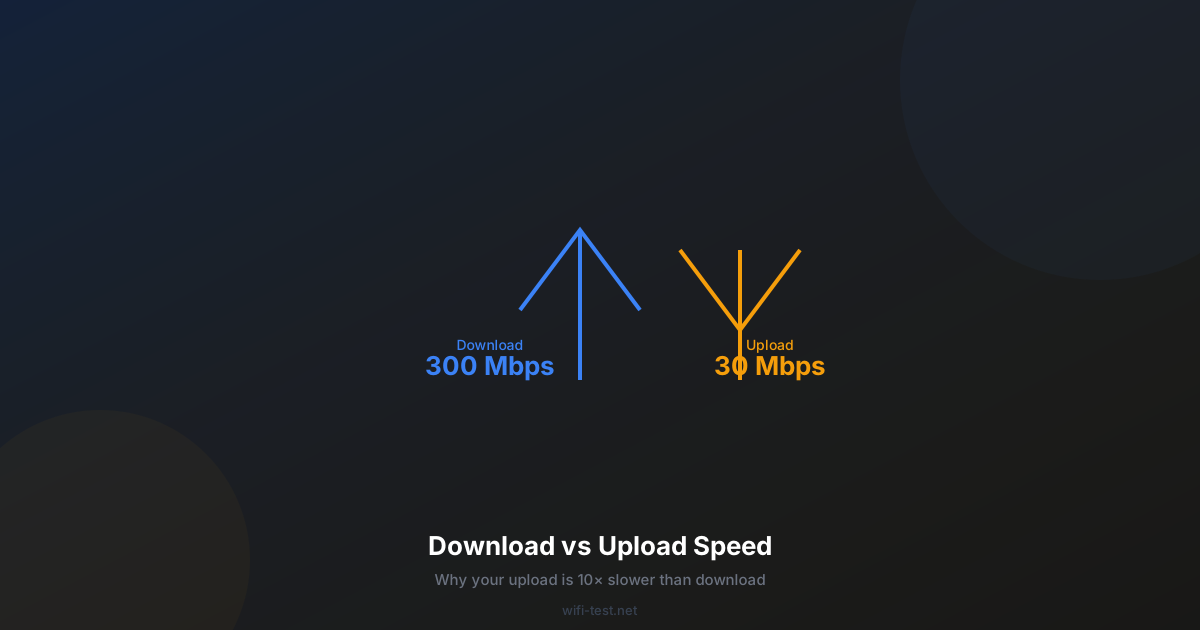
Your ISP's headline number is always download speed. Upload speed — often 10× smaller — is what limits video calls, cloud backups, and working from home. Here's the full picture.
1. What is download speed?
Download speed measures how fast data travels from the internet to your device. Every time you load a webpage, stream a video, receive an email, or update an app, you're using download bandwidth. It's measured in Mbps (Megabits per second).
Download speed is what ISPs advertise because it's the larger number and the one most consumers care about. "Get 500 Mbps!" sounds better than "Get 500/20 Mbps" — which is what many cable plans actually offer.
2. What is upload speed?
Upload speed measures how fast data travels from your device to the internet. Every video call frame you send, every file you save to the cloud, every photo you post, and every game state packet you transmit uses upload bandwidth.
For most casual internet users with cable broadband, upload speed is 5–35 Mbps on a plan advertising 500 Mbps download. That asymmetry is intentional — it reflects how most people historically used the internet (consuming, not creating). The work-from-home revolution has made this mismatch increasingly painful.
3. Why cable plans are asymmetric
DOCSIS (cable internet protocol) allocates more spectrum to download because the technology was designed for TV-era traffic patterns. ADSL and VDSL have the same asymmetry baked in. Fiber is inherently symmetric — the same glass carries data in both directions equally — but many fiber ISPs still offer asymmetric plans for competitive pricing reasons.
If you have fiber internet, you should be getting very close to your download speed on upload too. If you're getting 500 Mbps down and only 20 Mbps up on "fiber", check whether it's actually FTTP (fiber all the way) or FTTC (fiber to the cabinet, copper to your home).
4. Who needs fast upload speed?
Remote workers and video calls
A single HD Zoom call needs 3–5 Mbps upload. A 4K video call needs 15 Mbps. If two people in your home are simultaneously on video calls, that's 6–10 Mbps upload consumed — more than some cable plans offer on upload.
Content creators and streamers
Streaming to Twitch at 1080p 60fps requires 6–8 Mbps upload, consistently. YouTube Live at the same quality needs 4–6 Mbps. Uploading a 4K video to YouTube — a 10–30 GB file — on a 20 Mbps upload plan takes 1–4 hours. The same file on symmetric gigabit fiber takes under 5 minutes.
Cloud backup and NAS sync
Time Machine, iCloud, Google Drive, OneDrive, and Backblaze all upload your data continuously in the background. On a slow upload connection, these compete with every other upload task. Worse, they often saturate the upload channel entirely, which can cause bufferbloat — your download feels slow too because acknowledgement packets can't get through.
Gamers who host servers
Hosting a Minecraft, Valheim, or TeamSpeak server from home requires enough upload bandwidth for every connected player. At 1 Mbps per player, 10 simultaneous players need 10 Mbps sustained upload. See our gaming internet speed guide for more.
5. How to check your upload speed right now
Run the wifi-test.net speed test — it measures both download and upload in the same test, taking about 20–30 seconds. The upload figure is what your outgoing connection actually delivers (not what the marketing says).
While you're testing, also check your ping and jitter. Video calls and gaming are heavily affected by these — a 5 Mbps upload with 10ms ping is better for calls than 20 Mbps upload with 50ms ping and 20ms jitter.
6. Upload speed benchmarks by activity
- Casual web browsing: 1 Mbps (minimal upload)
- Social media posting (photos): 2–5 Mbps
- Video call (720p): 1.5–3 Mbps
- Video call (1080p HD): 3–5 Mbps
- Twitch streaming (1080p 60fps): 6–8 Mbps
- Remote desktop (low latency): 1–3 Mbps
- Cloud backup (continuous): 5–20 Mbps (uses all available)
- Uploading 4K footage: as fast as possible
7. When symmetric speeds matter
If you work from home, video call frequently, or create and upload content, symmetric internet — where upload equals download — makes a meaningful quality-of-life difference. Fiber providers offering symmetric gigabit plans (1000/1000 Mbps) include Verizon Fios, AT&T Fiber, Google Fiber, and most European FTTH providers (Free in France with Freebox Ultra, for example).
Check our guide on fiber vs cable internet to understand why symmetric upload is a fiber advantage, not just a spec on paper.
Conclusion
Download speed gets all the attention because it's bigger. Upload speed is what limits your video calls, cloud workflow, and content creation. If your upload speed is under 10 Mbps, it's worth understanding what's available in your area — symmetric fiber plans are increasingly accessible and not necessarily more expensive than asymmetric cable.
▶ Check your upload speed right now