WiFi 6E Explained: What It Is, Who Needs It, and Is It Worth It? (2026)
WiFi 6E is not just faster WiFi 6 — it's WiFi 6 operating in an entirely new frequency band with 7× more spectrum. That changes everything about congestion, speeds, and upgrade decisions.
1. WiFi 6 vs WiFi 6E: What's different?
WiFi 6 (802.11ax) brought major efficiency improvements — OFDMA, MU-MIMO, BSS Coloring — but still operated on the same crowded 2.4 GHz and 5 GHz bands that have been in use since the late 1990s. WiFi 6E takes all those same technologies and adds a third band: 6 GHz.
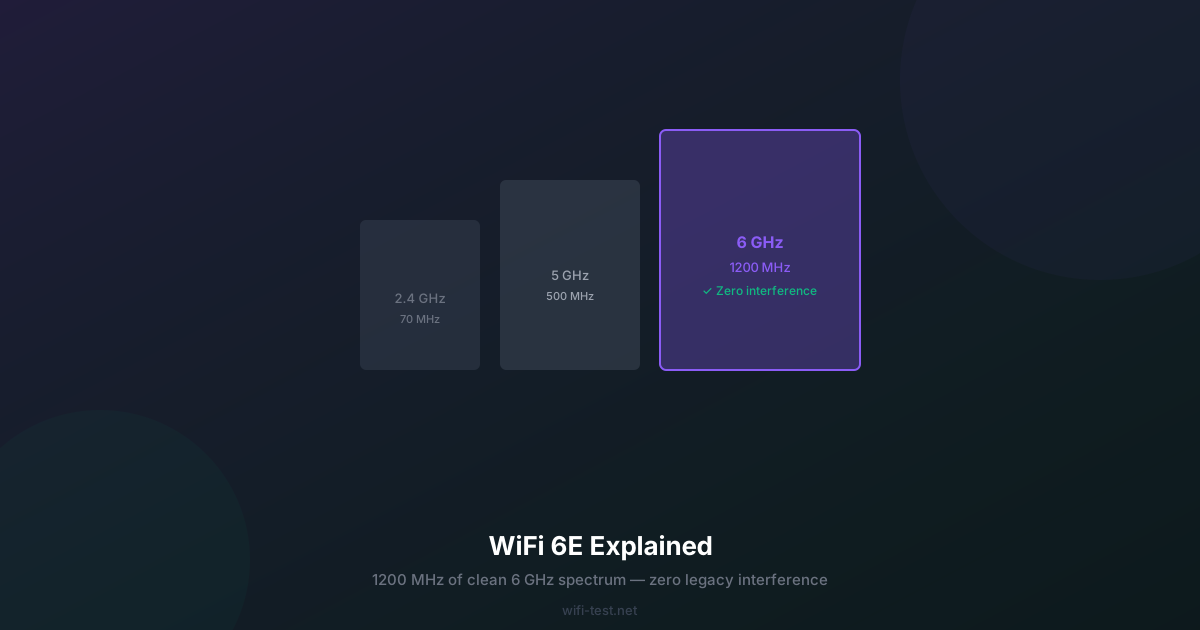
The result: 1,200 MHz of fresh, uncrowded spectrum in most countries (compared to just 70 MHz on 2.4 GHz and 500 MHz on 5 GHz). In the US, the FCC opened 1,200 MHz of the 6 GHz band in 2020. The UK and EU opened similar allocations in 2021. This single regulatory change made WiFi 6E genuinely different — not just incrementally better.
2. What the 6 GHz band actually delivers
- 7 non-overlapping 160 MHz channels (vs 2 on 5 GHz, 0 on 2.4 GHz)
- Maximum theoretical throughput: 9.6 Gbps (same as WiFi 6, but achievable with wider channels)
- Practical speeds: 1.5–3 Gbps at close range on a 160 MHz channel
- Latency: under 2ms in uncrowded conditions — lower than 5 GHz due to wider channels and zero legacy device interference
- Range: shorter than 5 GHz — 6 GHz signals attenuate faster through walls. Effective range is typically 20–30% less than equivalent 5 GHz.
3. Why 6 GHz is uncrowded (for now)
Only WiFi 6E and WiFi 7 devices can use the 6 GHz band. Your neighbour's 2015 router, smart home devices, baby monitors, microwave ovens, and Bluetooth devices are all invisible to the 6 GHz band. In apartment buildings where the 5 GHz band has 20+ competing networks, the 6 GHz band often shows zero competing networks.
This is the most underappreciated advantage of WiFi 6E in 2026. It's not that the technology is dramatically better — it's that you're operating in empty spectrum.
4. Which devices support WiFi 6E?
As of 2026, WiFi 6E is standard in flagship devices:
- iPhones: iPhone 15 Pro and later support WiFi 6E; iPhone 15 (standard) is WiFi 6 only. iPhone 16 and later: WiFi 6E.
- Android: Samsung Galaxy S23 and later, Google Pixel 7 and later, most 2023+ flagships.
- Laptops: Most 2023+ premium Windows laptops (Intel Core 13th Gen+, AMD Ryzen 7000 series) include WiFi 6E. MacBook Pro M2 and later: WiFi 6E.
- Gaming: PlayStation 5 (original: WiFi 6 only), PS5 Slim (2023): WiFi 6E. Xbox Series X: WiFi 5 only — still no 6E.
The critical limitation: if the device connecting to your router doesn't support 6E, it cannot use the 6 GHz band, regardless of what your router supports.
5. WiFi 6E vs WiFi 7: Should you wait?
WiFi 7 (802.11be) adds multi-link operation (MLO) — simultaneous use of 2.4, 5, and 6 GHz bands — and 320 MHz channels on 6 GHz. Theoretical maximum: 46 Gbps. As of 2026, WiFi 7 routers are available (ASUS ROG Rapture GT-BE98, TP-Link Archer BE900) but device support is still limited to 2024+ flagships.
If you're buying a new router in 2026:
- Budget/mid-range (under $150): A good WiFi 6 router is still excellent value. Few of your devices will have 6E support yet.
- Mid-range ($150–300): WiFi 6E is the sweet spot — devices are catching up, spectrum is clean, prices have dropped significantly since 2022.
- Premium ($300+): WiFi 7 makes sense if you have multiple 2024+ devices and want to future-proof for 3–5 years.
6. Real-world WiFi 6E speed tests
Benchmarks at various distances from a WiFi 6E router (TP-Link Archer AXE75, 6 GHz band, 160 MHz channel):
- Same room (3m, clear LOS): 2,100 Mbps down, 1,800 Mbps up
- Adjacent room (8m, 1 wall): 1,100 Mbps down, 900 Mbps up
- Two rooms (15m, 2 walls): 380 Mbps down, 310 Mbps up
- Three rooms (20m, 3 walls): 85 Mbps down (signal lost on some devices)
Comparison: at 15m with 2 walls, the same router's 5 GHz band delivered 520 Mbps — faster than 6 GHz at the same distance. The lesson: 6 GHz wins on speed and latency at close range; 5 GHz maintains better coverage.
7. Who should upgrade to WiFi 6E now?
Yes, upgrade if:
- You live in a dense apartment building with heavy WiFi congestion on 5 GHz.
- You have multiple 2022+ devices (iPhones, MacBooks, flagships) that support 6E.
- You need low-latency performance for VR, gaming, or video production.
- You're replacing a router that's 4+ years old anyway.
Wait if:
- Your current router is less than 2 years old and performs well.
- Most devices in your home are more than 3 years old (no 6E support).
- You live in a house with good coverage from an existing 5 GHz setup.
Conclusion
WiFi 6E's real value in 2026 is the empty 6 GHz spectrum, not raw speed. In congested environments, a WiFi 6E router gives your capable devices a dedicated lane with zero competition. Test your current WiFi speed — if you're getting less than 50% of your theoretical maximum, congestion (not hardware) is likely the bottleneck, and 6E solves exactly that.
▶ Test your current WiFi speed